
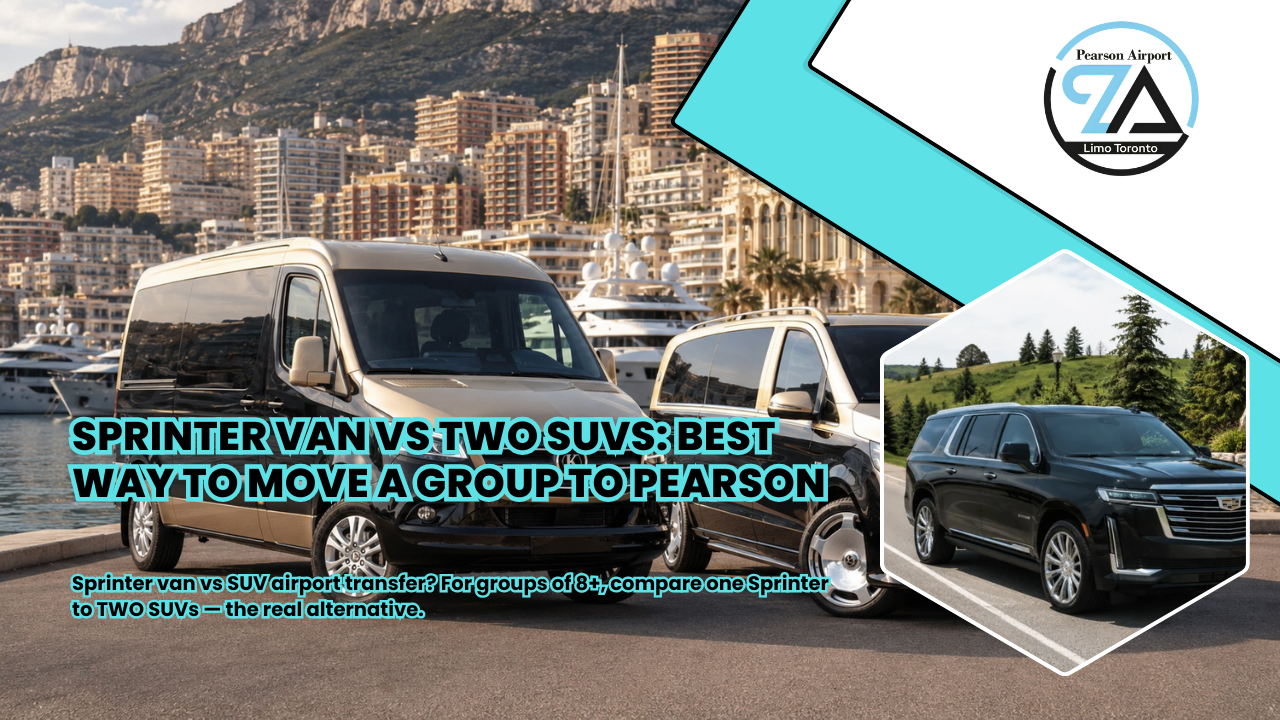
Picture ten people flying into Pearson together, each with a checked bag and a carry-on, all trying to reach the same hotel downtown. A full-size SUV seats six or seven and has a normal cargo area — it physically cannot hold ten people and their luggage. So the group defaults to two SUVs, and that is where the day quietly falls apart: two drivers, two pickups, two arrival times, and a decent chance that half the group is standing at the curb while the other half is still fifteen minutes out. This is the heart of the Sprinter van vs SUV airport transfer decision, and for most groups of eight or more it has one clear answer.
The real comparison isn’t one Sprinter vs one SUV
Here is the mistake almost everyone makes: they compare one Sprinter van to one SUV, see a higher number next to the van, and stop there. But if your group does not fit in a single SUV, one SUV was never the real option. The real comparison is one Sprinter van versus two SUVs — because two SUVs is what it actually takes to move the group. Framed that way, the math and the logistics both tilt toward the van.
Rule of thumb: Six or fewer travelling light → a single full-size SUV. Eight or more, or any group with real luggage → one Sprinter van. The tipping point is around seven to eight passengers.
Head-to-head: one Sprinter van vs two SUVs
When you line the two options up side by side across the things that actually matter on an airport run, the pattern is hard to miss.
| What matters | One Sprinter van | Two full-size SUVs |
|---|---|---|
| Passengers | The whole group (about 10–14) in one vehicle | Split across 2 vehicles, ~6–7 each |
| Luggage | Dedicated cargo area — bags don’t ride on laps | Tight once every seat is full; may force a 3rd vehicle |
| Arrival | Everyone arrives together — one curb, one time | Two arrival times; a real chance of a split across T1 and T3 |
| Coordination | One booking, one chauffeur, one point of contact | Two bookings, two drivers, double the moving parts |
| Per-person cost | One flat rate split across the group | Two flat rates — often higher per head at 8+ passengers |
| Winter / delays | One flight-tracked vehicle to watch | Two vehicles, two chances for a weather or traffic delay |
Seats and luggage
A full-size SUV — an Escalade, Suburban, or Yukon — comfortably seats six or seven passengers with light luggage. Fill every seat and the cargo space disappears fast; seven passengers with a checked bag each will not fit without a roof carrier or a second vehicle. A passenger Sprinter van carries the whole group, roughly 10 to 14 with luggage, in one climate-controlled cabin with a dedicated luggage area behind the last row. If you are unsure exactly how many seats you need, our guide on how many passengers fit in a Sprinter van breaks it down.
The Pearson problem with two vehicles
The single biggest advantage of one vehicle is that your group arrives as one group. Two SUVs leave from two spots, hit traffic differently, and can pull up to arrivals minutes apart — sometimes at different terminals entirely if the drivers read the pickup differently. At a place as busy as Pearson, where Terminal 1 and Terminal 3 are a shuttle ride apart, a split arrival means part of your group is waiting curbside with the bags while the rest is still circling. One van removes that failure point completely: one driver, one meeting point, one arrival.
Coordination
There is a real cost to two vehicles that never shows up on the quote. Two SUVs means two chauffeurs to coordinate, two flights of communication, two vehicles to track, and two curbside pickups to time. If one SUV runs late, someone in your group is left waiting — the kind of small, avoidable problem that happens specifically because the group was split. One Sprinter collapses all of that into a single booking with one point of contact.
Comfort and the ride itself
Comfort is the quiet difference over a 45-minute run into the city. A Sprinter has upright seating, high ceilings you can nearly stand under, and room to keep bags off laps — nobody is folded into a third row with a suitcase on their knees. Two SUVs also split the group socially: the team that wanted to debrief before a meeting, or the family that wanted to travel together, ends up in separate vehicles having separate rides. One van keeps everyone in the same conversation.
The cost math most groups miss
On price, the comparison people skip is the important one. A single SUV is cheaper than a Sprinter — that part is true. But two SUVs usually are not. When you divide one Sprinter’s flat rate across ten or twelve passengers, the per-person cost frequently lands below what two SUVs would cost split the same way, and you are getting one coordinated trip instead of two. Because our rates are flat, the number you are quoted is the number you pay — which matters even more when the cost is being split among the group and nobody wants to explain why the final bill came in higher than expected. For your exact numbers, request a quote with your group size and route.
When an SUV is still the right call
None of this means an SUV is the wrong choice — for the right trip it is the better one. If your group is six or fewer and travelling light, a single full-size SUV is more agile, easier at the curb, and usually the lower total cost. Executives moving between meetings, a couple heading to a wedding with family, or a small team on a quick turnaround are all classic SUV trips. The tipping point is around seven to eight passengers, or any group where luggage is a real factor. Past that line, the Sprinter almost always wins — see what size vehicle you need for a group for the full breakdown.
Why book one Sprinter van with Pearson Airport Limo Toronto
When you book one Sprinter van for your group with us, you get more than a bigger vehicle. Our rates are flat, with no meter and no surge when a wave of flights lands at once. We track your flight in real time, so a delay does not cost you the booking. Meet-and-greet puts a chauffeur inside the terminal with a name sign to help gather everyone and their luggage, and certified child seats are available on request. It is one vehicle, one driver, and one plan — built so your whole party leaves Pearson together, on time. See how our Pearson airport transfer works for groups.
5 tips before you decide
- Book for the group you actually have. Not the option that looks cheapest at first glance — count both passengers and bags.
- Compare the Sprinter to two SUVs, not one. When your count is near the SUV’s limit, that is the real alternative, and it usually changes the answer.
- Share every flight number and pickup address. One flight-tracked van can wait for the whole group and collect from a couple of stops on the way.
- Ask for a flat, all-in quote. Splitting one predictable rate beats reconciling two separate bills after the fact.
- Book early for peak windows. Conference season, long weekends, and holiday travel — the right van goes first.
Frequently Asked Questions
Is a Sprinter van cheaper than two SUVs?
For groups of eight or more, one Sprinter van is usually cheaper per person than two SUVs. A single SUV costs less than a Sprinter, but two SUVs — which is what it takes to move eight-plus people with luggage — often cost more per head than one van, on top of the added coordination.
How many SUVs do I need for a group of 10?
A full-size SUV seats six or seven passengers, so a group of ten needs two SUVs. One Sprinter van carries the whole group of ten, with luggage, in a single vehicle — which is why most groups of ten book a van instead.
Do two SUVs arrive at the airport together?
No. Two SUVs leave separately and can reach the airport at different times, sometimes at different terminals. If keeping your group together matters, one vehicle is the only way to guarantee a single arrival.
Should I book an SUV or a Sprinter van for an airport transfer?
Choose an SUV when your group is six or fewer with light luggage and you want an agile, private ride. Choose a Sprinter van when you have roughly eight or more passengers, heavier luggage, or you simply want everyone to travel together in one vehicle.
Does a Sprinter really hold more luggage than two SUVs?
Yes. A Sprinter van has a dedicated luggage area, so a group of ten to twelve can bring a checked bag and a carry-on each without stacking anything on laps — something two fully seated SUVs often cannot manage.
The bottom line
The Sprinter van vs SUV airport transfer choice comes down to one honest comparison: not one van against one SUV, but one van against the two SUVs it would actually take to move your group. For six or fewer travelling light, book the SUV. For eight or more, or anyone with real luggage, one Sprinter keeps your group together, simplifies everything, and usually costs less per person. Keep your whole group in one vehicle — reserve a Sprinter van today, or get a quote for your group and route.